Showing posts with label photography. Show all posts

Wednesday, August 21, 2013

And the living is easy...


Here in San Antonio, despite the continued triple-digit temperatures, summer is most definitely winding to a close. School inexplicably begins the week before Labor Day (this either has to do with bureaucratic hokum or with air-conditioning), so we've got little choice in the matter: The new lunch boxes, backpacks and shoes have all been procured; the outdoor pool at the health club is now closed so the lifeguards can get educated; even our own pool has become mysteriously chilly. Last week I tried to get my kids their umpteenth pair of replacement goggles only to find that the pool section at the sporting goods store had been subsumed by the hunting and fishing department. No more wacky noodles, no more inflatable recliners. All of which leads me to believe that there's a conspiracy to make us forget that summer actually ends on September 21, not August 25, so we'll sooner submit to the lash of structure and routine and punctuality and carpooling and early-birds-always-getting-the-worm. Bleh.

But before it's too late, before Summer turns into a pumpkin, I wanted to share this dreamy coffee table tome I picked up at the used-book store at our city library (a signed first edition—I love that store!): Summer Places, written by renowned critic/bon vivant Brendan Gill and photographed by Dudley Witney. Published in 1978, it's a quintessential hostess gift—a visual survey of the great, historic summer towns and summer homes across North America, along with some nostalgic summer rhapsodizing courtesy of Gill:
Unfailingly, summer places have been the agreeable ghosts that accompany me throughout the winter and help me survive its bitter humors. They are robust and yet tender-hearted ghosts, not shadowy, unfeeling ones, and I hold out my hands to them for warmth. As I grow older, these ghosts of mine remain ever the same age, ever youthfully on tiptoe. It is morning with them; there is dew on the tops of the hedges among which they stand and somewhere far off a glint of sea.
I spent the bulk of my childhood summers at the Jersey Shore, a place that's full of robust yet tender-hearted ghosts so I think I know what he's talking about...

But does anyone read the text in a coffee-table book? It's all about the photos. Some of the ones in this volume are a bit blah to my eye; too many architectural details of grand old seaside hotels, too many empty landscapes. It feels a little lonely, like maybe it should've been titled Off-Season Summer Places. I prefer the photos that feature actual human vacationers (maybe because I like to look at the clothes, hairstyles and eyewear). Still, it's all here—the salty breezes, the smell of lake on your swimsuit, the creak of a saddle, the clamor of the boardwalk, the clink of boats nudging the dock... Sayonara, Summer.

Playing shuffleboard and beanbag in Quebec


On the beach in Galveston, TX


East Hampton, Long Island, NY


Asbury Park, NJ


Camp at Lake Timagami, Ontario


Ranch near Cody, WY


A shell shop in Galveston, TX


Monday, July 29, 2013

Bonsai and cigarettes


I am a known houseplant murderess, which is a drag considering what an important role a few well-chosen plants plays in attaining that midcentury-to-1970s design vibe. But I shouldn't really have plants in good conscience, and I certainly can't have bonsai. The guilt of tossing a snake plant (a.k.a. mother-in-law's tongue) after a year of hard duty in my sun-scorched house and simply replacing it with another $10 specimen from Home Depot pales next to killing one of these ancient jewels of the herbaceous world, the product of millennia of painstaking study and artistry practiced in various parts of Asia since at least the 6th century.

Though I do get tempted. There is an elderly gentleman in my neighborhood who sells bonsai from a rickety old book case in the gas station parking lot across from the middle school. (Normally a place you'd expect to see a taco truck in these parts, but, no—bonsai.) But I resist and make do with adorable books about adorable bonsai, like Bonsai Miniatures Quick & Easy published in 1973 by a fellow named Zeko Nakamura, described as a Zen Buddhist acolyte-turned-famous-movie-and-television-comedian. And renowned bonsai expert of his day, apparently.

But what I really love about this book is the way the bonsai have been photographed alongside cigarettes, matchbooks and attractive men's watches to show their diminutive scale. Genius!


"A light-hearted approach"


Note the matchbox next to the bonsai containers. Yes, that's how small they are. I want to eat these containers they're so dang cute! 

Cherry blossoms and ciggies. Another freaky juxtaposition.


Monday, April 29, 2013

Estate sale discovery: Constance Bannister


I picked this book up at a sale a couple of years ago. I think I spent about ten seconds perusing the pictures before tossing it in a box to be sifted through at some future date. Well, the future date finally arrived and I was able to confirm what I already knew: I'm not a cute baby fetishist and never will be. You will never catch me with an Anne Geddes calendar or a baby doll collection (unless those babies are wooden and weird!). And though what passes for humor in Members of the P.T.A. by Constance Bannister is obviously dated, I'm reasonably certain I would not have found it funny had I been a mother of small children when it was published back in 1970.


But I also confirmed something I else I already knew—that you can make all sorts of interesting pop cultural-historical discoveries while shopping estate sales and library sales. This Constance Bannister was no one-hit-wonder novelty book author; she was an incredibly cool, ahead-of-her time woman with the kind of story that's ripe for a high-end biopic miniseries on one of the prestige networks (HBO, AMC, Showtime, are you listening?). Think Kate Winslet in the title role. Go to the website her daughter has created in her honor to check out a babelicious self-portrait of Ms. Bannister circa 1940. 


So Constance Bannister was a babealicious baby photographer; in the words of the headline for her New York Times obit—she died in 2005—she "photographed 100,000 babies." Her beginnings were inauspicious and reminiscent of more than one legendary country-western singer: She was born in 1913 in Ashland, Tennessee, one of 17 children. As a teenager, she moved to NYC to attend the School of Modern Photography. This was the 1930s, people—that took some serious pluck, don't you think? She moved to Palm Beach to work as a society photographer for the Associated Press. After a few years, she returned to NYC, where she opened a studio and photographed Broadway plays, ballets and the Ice Capades. Somewhere along the way she started photographing babies and pets.  In the ’40s and ’50s, the "Bannister Babies" became something of a phenomenon, appearing on the Perry Como Show, the Frank Sinatra show, Ernie Kovacs, etc. while Bannister was also shooting total midcentury eye-candy covers for Woman's Day, LOOK and McCall's. She published tons of books and had a syndicated comic strip. She was a bona-fide pinup during WWII. She married three times and adopted two daughters. She apparently photographed a baby Christopher Walken. Don't you want to know more about this unsung heroine? I know I do.


Thursday, May 17, 2012

I spy, with my little eye...

Memories II, 1976

When my five-year-old saw these images on my computer, she flew at the screen like a magpie, squawking "What is that?! What is that, Mommy?" I think part of the attraction is that Marie Cosindas's tableaux are kinda reminiscent of Walter Wick's I Spy books. That's a terrible thing to say about fine art, right? The other reason is that artful(ish) piles of clutter are a specialty in these parts, and my daughter is an extra-special fan (no one loves sorting the old tackle box more). There was a brief moment when I actually thought about drawing from our own abundant tchotchke resources and shooting my own I Spy photographs and then turning them into books on Shutterfly and then I thought if I really had time to do that sort of project hadn't I ought to start looking for a paying job?

According to Tom Wolfe's introductory essay to Marie Cosindas: Color Photographs, Cosindas was also something of a young magpie:

Rich, congested, and yet delicate and orderly arrangements were the sort Maria Cosindas delighted in. It was a look that resonated with memories of her childhood. In the apartment that she and her nine brothers and sisters grew up in, there was a corner with a little built-in cupboard that became her private preserve. She used to spend entire afternoons arranging every toy, knickknack, doll, and souvenir she possessed upon the shelves. The motif turns up in both of her pictures called Memories.

How great is that? Of course she had her own Cabinet of Curiosities, a la Pippi Longstocking. No wonder I love these photos, even though they are all creepy and Havishamy and I can feel the dust gathering in my nostrils just looking at them. It's a familiar feeling.

Christmas Tree, 1967

Christmas Still Life, 1970

Roses, Mexico, 1966

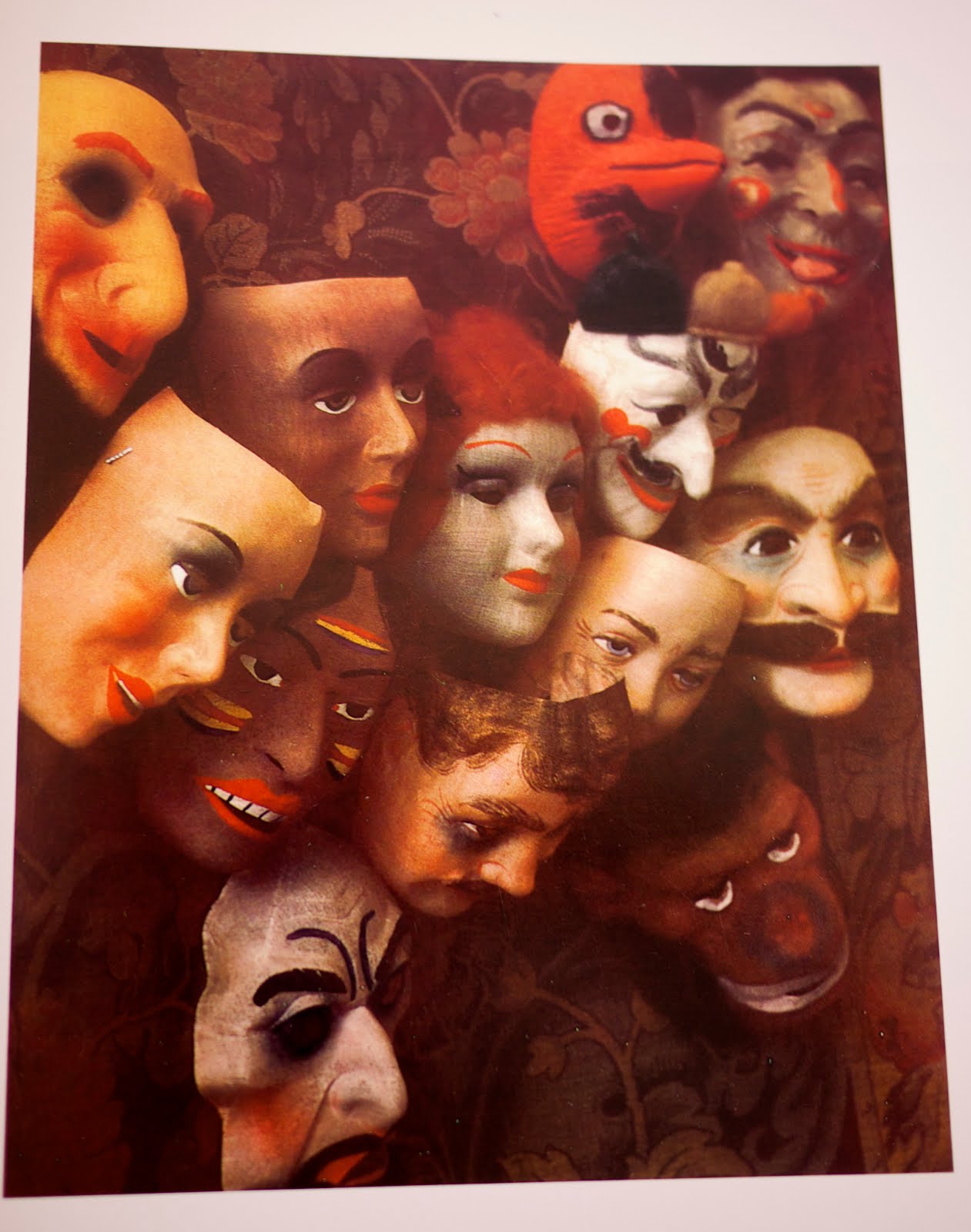
Masks, 1966

Wednesday, May 16, 2012

Cosindas: portraits of the artists

The Grande Dames of Couture: Madame Gres, 1969

There are so many great pictures in this Marie Cosindas: Color Photographs book; my choices are feeling a little random and as usual, my pitiful picture-taking ways do them no great justice. Still, you get the idea. I don't know a lot about this lady. I think she's still living. She's Greek-American, from the Boston area, went to art school and to fashion school in Boston. According to Tom Wolfe's introductory essay (he sat for her once), she walked out on her last fashion job, which involved designing children's slippers with animal faces to match hand puppets, and decided to devote herself to photography. She studied alongside Ansel Adams and Minor White. She worked in black and white because all fine art photographers did; photographers who worked in color were considered commercial or journalistic. Wolfe does a funny riff on the "fine artist's Reverence for the Outmoded":

Artists like to be regarded as visionaries, but I can't think of a group of people who resist change more fiercely and bitterly. Most of the artist's visionary acuity is over his shoulder. As the art historian Alan Gowans has demonstrated, artists did not regard the woodcut, the steel engraving, and the lithograph as "artistic" media until they had been rendered obsolete by the photogravure. The more self-consciously artistic movie directors clung to the black-and-white film for years because Technicolor had superseded it with mass audiences.

That's not how it turned out for color-mad Cosindas. In 1962, Polaroid approached about a dozen photographers, including Cosindas, with an offer: take a large quantity of their new color film, Polacolor, which was going on the market the following year, and just experiment with it. The only one who had any success was Cosindas. Her photographs are dark, lush, rich, painterly—like late Renaissance paintings. Her technique was exacting; her process incredibly time-consuming and apparently pretty tedious for the subject (unless the subject was a flower or pile of objects—will share her awesome still lifes tomorrow).

My copy of her book has an inscription on its inside flap to the original owner: "To Bob Saunders, From Polaroid." (Thinking Bob must've been a local camera store owner or something along those lines; doesn't look like he cracked the book but once.) Which brings me back to Wolfe and the Reverence for the Outmoded: Who loves Polaroids—and the Polaroid effects rendered so easily by the touch of finger to screen via Instagram, Hipstamatic, etc—more than my generation, the retro nostalgists who thrill to images that remind us of our 60s/70s childhoods? Track down this out-of-print book and be reminded of what separates the fine artists from the fine Instagrammers—and imagine a generation hence when the backward-looking fine artists might well be Instagrammers.

The Grande Dames of Couture: Madame Vionnet, 1969

The Dandies: Andy Warhol, 1966

Truman Capote, 1969

Ezra Pound, 1967

Tuesday, May 15, 2012

Marie Cosindas, where have you been all my life?


How do we educate ourselves when we're no longer in school? Grad school is my road not taken. I did Stanley Kaplan, took the GREs, applied and got in, but I never ended up going. I don't regret that choice but often wish I were in grad school right now, pursuing that PhD in 19th-century medievalism with the stipend and TA job I was promised back when I was in my early twenties and all that stuff was fresh in my brain. Oh well, perhaps one day I will be the sort of senior citizen who audits classes at the local university (cuz there is no way I could get a vaguely respectable score on the math GRE today—I barely squeaked by the first time around). Till then, I have estate and library sales doing the work of furthering my education, and I don't have to take out any loans to make it happen (at least, it hasn't come to that—yet). For example, I can credit an estate sale with introducing me to the work of Marie Cosindas, yet another photographer I've never heard of but whose work I now totally dig. I'll be featuring photographs from Marie Cosindas Color Photographs (New York Graphic Society, 1978) all week as I regroup after my discombobulating long weekend in NYC. As most excellent poet Sara Teasdale wrote:
I shall gather myself into myself again,
I shall take my scattered selves and make them one.
I shall fuse them into a polished crystal ball
Where I can see the moon and the flashing sun.
Julie and John, 1976

Barbara and Fred, 1976

Faye and Peter, 1976 (Yes, as in Faye Dunaway and Peter Wolf—wowsie wow wow)

Stephanie, Elaine and Tony, 1976

Wednesday, May 2, 2012

Diesels and Dinosaurs


I would never have described myself as much of a fine-art photography buff until I started buying books of photography by photographers I'd never heard of at estate sales (and apart from Arbus, Sherman and Mapplethorpe, I hadn't heard of too many). I found this beautiful hardcover copy of Steve Fitch's Diesels and Dinosaurs: Photographs of the American Highway buried under piles of sewing patterns in someone's craft room. It was signed by the photographer to someone named Irma (the crafter?) in 1985. Close readers of this blog may remember a certain sewing book with a risque bookmark, which came from the very same craft room. Who was this Irma anyway? She seems like she must've been fun. Well, anyway, this book is gorgeous; Fitch took these photographs in the early 70s, when he was in his early twenties. But they are pretty timeless. To quote from the impenetrable artspeaky blurb on the jacket flap: "There is a sense of place...that is placeless...They are monumental yet banal. They are forces yet essentially directionless..." Okay, I think I agree with that assessment, but you should just look at them. My attempt to photograph Fitch's photographs is pretty pitiful; to get a much better idea of his work, go here.

Snakepit operator, Hwy 66, Sayre, OK 1973

Billboard, Hwy 66, near Albuquerque, NM 1972

Drive-in theater, Highway 81, Waco, TX 1973

Diorama, Hwy I-75, Gaylord, MI 1973

Thunderbeast, Hwy 97, Chiloquin, OR 1972

Related Posts Plugin for WordPress, Blogger...