Tuesday, January 22, 2013
Hello, World's Fair dolly
My mom brought me this knock-kneed fashion doll on a recent visit to Texas. She'd been reminded of my affection for weird big-eyed 1960s-era fashion dolls when I wrote this post. In a nutshell, it recounts the story of how one time when I was back in the Jersey hometown on vacation, I paid a visit to my favorite local thrift shoppe and purchased a weird big-eyed 1960s fashion doll and when I proudly showed it to my mom, she was like, duh, I donated that doll to the thrift shoppe! And I was like, duh, Mom, why? Of course I would want that! Stop donating things I want!
Anyway, the conversation went something like that—just excise all the "duhs." It's the sort of mix-up that only happens in my family. And I think this is the kind of score that only happens in NJ—I mean, I definitely don't get to scoop up adorable freaks of nature like this for a buck at garage sales in San Antonio! Especially big-eyed freaky fashion dolls that turn out to be World's Fair collectibles. This little lady is Miss New York, modeled after the hostesses at the 1964 World's Fair in NYC, which given the date and the location was no doubt the best of all World's Fairs. And she's worth a fair bit more than a dollar; not that she's for sale, nor will she be donated to any thrift shop. Of that, you can be sure.
Friday, January 18, 2013
More midcentury goodness from the etsy shoppe
I've been scanning and photographing and uploading and tinkering with photos of books for the past few weeks and let me say, I'm not sure if etsy is worth the trouble! But I'm not going to give up. At least, not yet. Any day now, vintage children's books will be raining down on ye olde Thingummery shoppe, just in time for the shopping madness that traditionally precedes the President's Day holidays. (Seriously, are you counting down the days like I am?) Till then, continue to feast your eyes on these scrumptious photos taken from the pages of my collection of decorating, gardening and cocktail books, and then feel free to go buy them if the spirit moves you.
Thursday, January 17, 2013
More things I didn't buy, starting with the Un-bra
I did not buy the Un-bra because I have a strict no-undergarment-buying policy when shopping estate sales. One must set limits.
I did not buy this defaced (or faced?) mannequin head, but I did appreciate the effort.
I did not buy a stack of back issues of Analog: Science Fiction and Fact magazine, though I did mourn the passing of another loyal print subscriber. I assumed this digest, which has been published since the 1930s, couldn't possibly still exist but, lo, it does! You can even get it on your Kindle. This first line of description of the latest issue is making me regret my decision to pass up this trove: "By pure coincidence, our March issue offers a denser than average population of nonhuman intelligences, and quite a collection they are."
I did not buy any $80 hub caps. I didn't even buy the cheaper hub caps.
Tuesday, January 15, 2013
Being Ramona (an appreciation of Beverly Cleary)

I don't have a sister. I have an older brother, which I think is the least fraught sibling dynamic there is, but I could be biased. Until I became a mother, everything I knew about sisters I knew from literature or some facet of pop culture: Pride & Prejudice. The Brady Bunch. The Roches. Little Women. King Lear.
But now I have two daughters, three and a half years apart, whose relationship, depending on the moment, fascinates, amuses or frightens me. I also have different sister source material: the oeuvre of Beverly Cleary, whose books I've amassed at my usual haunts—library sales, estate sales and thrift stores. I'm sure I read a good chunk of the Ramona series when I was kid, but the stories didn't make any lasting impression—a fact I attribute to her lack of equine characters. I also didn't have a sister, and the Ramona books are about a lot of things, but mostly they're about Ramona and Beezus, two sisters, about five years apart, whose relationship in turn fascinates, amuses and frightens.
Cleary is a miniaturist, a crafter of tiny domestic dramas. This has become a bad word in contemporary literature—purportedly a way of denigrating women writers. Like, why is a novel considered "miniature" when [insert female novelist who rarely or never gets reviewed by The New York Times here] writes it, but when, say, Jonathan Franzen makes the foibles of an affluent suburban hausfrau his subject, then it's a novel of Big Ideas (probably helps to give big-idea-sounding titles like Freedom. Just sayin'). Anyway, I don't consider miniaturism to be a negative. I live my life in miniature; my dramas are mostly domestic, quotidian affairs, and when a novel mirrors my experience and makes it universal, that's a good novel, whatever you want to call it.
The Quimby family saga is nothing if not universal, even if the scale is small. Anxiety about money pervades all. In the Quimby household, nothing is disposable. Making one pair of oxfords last a whole school year is paramount. Buying and then losing a pair of red rain boots is a very big deal. Mr. Quimby loses his job and the family can no longer afford a weekly dinner at the local hamburger joint. Mrs. Quimby gets a job as a receptionist at a doctor's office. Ramona throws up at school. Ramona doesn't think her teacher likes her. Ramona is babysat. Beezus becomes a babysitter. Ramona ruins a library book. The family cat dies. Beezus goes to her first party with boys. A surprise third child is born. A stray dog is acquired. A bike is procured. An aunt gets married. Dad quits smoking. Etc. Etc. All the stories are about learning how to negotiate relationships—with our immediate family and distant relations, our friends and frenemies, our neighbors, teachers and babysitters. They're all about getting along.
And what better way to illustrate that point than with the story of two (competing-bickering-loving-hating) sisters?
Around here, we use Ramona as shorthand. We tell my younger daughter, when she is being pesty for the sake of pestieness, "Don't be such a Ramona." When the older one's sense of injustice and outrage is made palpable by a quivering upper lip, we say, "No need to get all Beezus on us." When our cat died, we talked about Picky-picky and how the girls buried him themselves in the backyard and what that must've been like. When they complain about dinner, they're reminded of the time Mr. and Mrs. Quimby put the sisters in charge of making their own damn dinner. If they make a new friend who's a boy, we wonder if he's a Henry, or more of a Howie? There is a subtle difference...
When my elder daughter was in first grade, we started reading the books together. By second grade, she was reading them on her own and in school. The younger one, eager to get in on any of her sister's action, became hooked on the audiobooks in preschool. For about a year, the husky, cultured voice of Stockard Channing, who plays every role in every Ramona book ever written, could be heard booming from the kid side of the house. (I always thought Rizzo was the best part of Grease, but Channing's work in these audiobooks might be her best ever.)
Then the Ramona & Beezus movie came out, starring that cute brunette who just broke up with Justin Bieber and the soap-opera guy who's married to Fergie from the Black-eyed Peas and the guy who was Carrie's second-to-last serious boyfriend on Sex and the City and the chick who plays one of the sisterwives on that Mormon show on HBO. And I was worried. I didn't want my kids' appreciation of Beverly Cleary's elegant prose (or Stockard Channing's amazing voice) to be tainted by some watered-down Hollywood bullshit. I'm so principled! Until it came to HBO one rainy day and I was like what the hell? We're paying for HBO for god's sakes—watch it.
I think they watched it 17 or 18 times before I was finally able to delete if from the Tivo.
My only real problem with the movie—a harmless enough travesty, as these things go—is the repackaged movie tie-in paperback, which features the actresses on the cover. My elder daughter insisted on buying this version for her little sister, despite the fact that we already have an extensive Beverly Cleary collection. There are many, many versions of Cleary's many, many books out there. Once I snapped up the 1975 first edition hardback of Ramona the Brave pictured here, which features the awesome illustrations of Alan Tiegreen, I was on a mission to find them all. Along the way, of course, I had to buy all the other versions, like the Dell Yearling paperbacks from the mid-’80s, illustrated by my second-favorite Louis Darling. We have a bunch from the ’90s, and then my daughters' favorite—the HarperCollins reissues from the early 2000s. They prefer these covers because the idealized, longer-haired version of the characters make them look "prettier." Ugh.
But I get it. They identify with Ramona and Beezus and they want them looking the way they want to look, Disney Channel-ready, not like some kid from the cast of Zoom. Which I realize is why I like Tiegreen's knobby-kneed tomboy Ramona best: that's the version that most reminds me of myself circa 1975, when we sported bowl cuts and wore overalls and ruled the sidewalks on our rollerskates and banana-seat bikes, just like the kids from Klickitat Street. I'm pretty sure that everyone who's read and loved these books can answer the question: Are you a Ramona or a Beezus? I may be a Mrs. Quimby now (alas) but once upon a time I was definitely a Ramona. Just ask my brother.
Tuesday, January 8, 2013
Black and white and no longer read all over
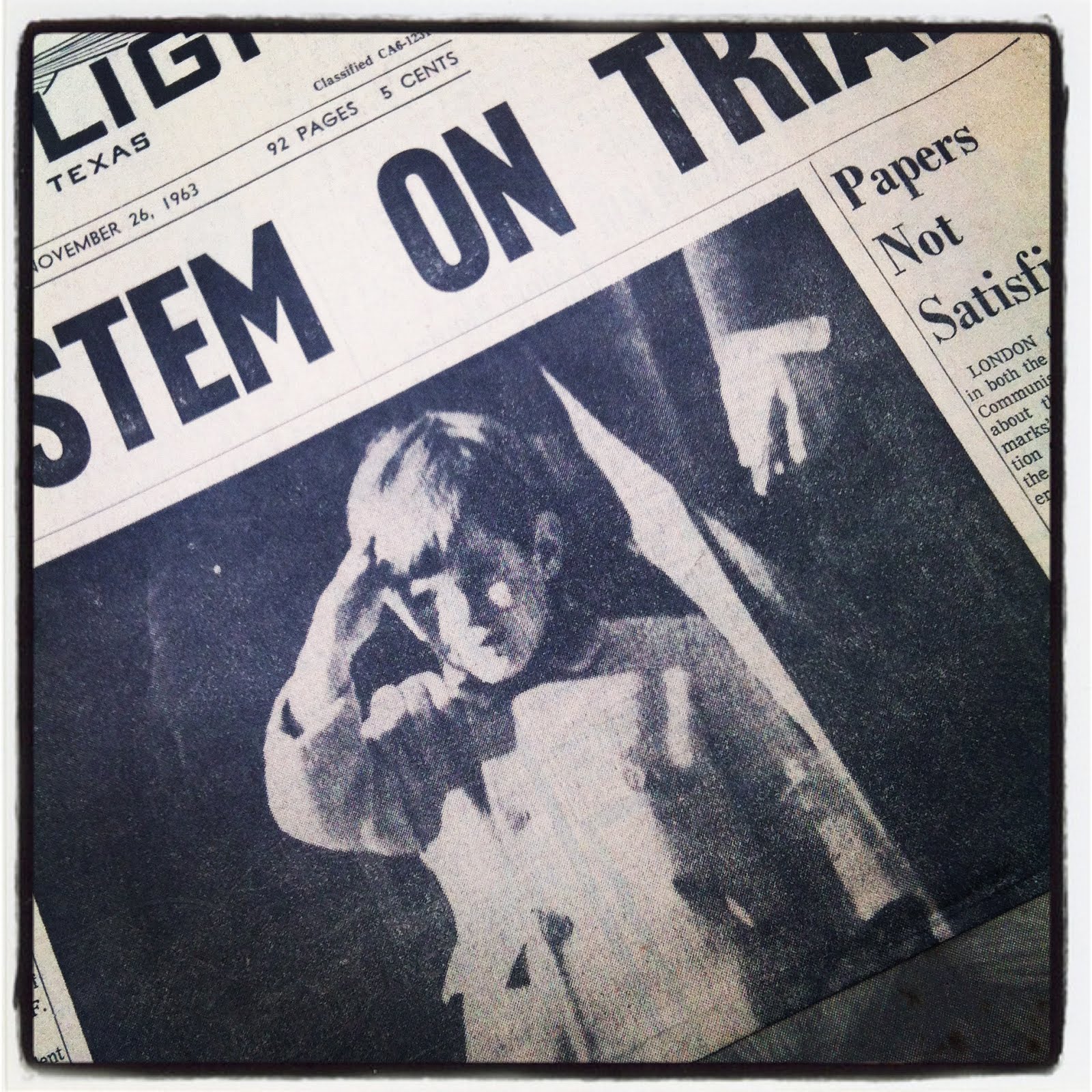
I wonder if anyone ever buys the old newspapers that old people save? Pretty sure everyone at this estate sale passed over these crumbling broadsheets with their milestone headlines—JFK's funeral, Macarthur's death, a tribute to Natalie Wood in the "ladies' pages." I know I did, though I did pause long enough to instagram them. And I say this as a person who still has the local rag delivered to her doorstep (well, the mouth of my driveway, not the doorstep literally) and gets the New York Times on Sundays (though I don't want to calculate how much that bit of sentimentality is costing me). I have a basketful of magazine, catalog and newspaper clippings in my office, and in my Big Scary Closet Full of Ephemera and Holiday Decorations, you'll find my own collection of saved newspapers—the Times and the NY Post from the week of 9/11, as well as a pile of British papers trumpeting Princess Di's death (it so happened I was in England during that crazy time).
Of course I haven't stored them properly in archival boxes or wrapped them in acid-free paper so they're going to deteriorate just like the ones here, which had been saved for decades and then...what? Thrown away, I imagine. Hopefully recycled. With the advent all things digital, an entire category of vintage goodness is vanishing: ephemera. Transient bits of paper that were never meant to be saved, but we saved them anyway. Wikipedia lists the following as "collectible ephemera": advertising trade cards, airsickness bags, bookmarks, catalogues, greeting cards, letters, pamphlets, postcards, prospectuses, stock certificates, tickets and zines. I'm trying to imagine a clean, streamlined. umusty future where there's no ephemera, except for airsickness bags. I don't see a digital alternative for those, yet.
Monday, January 7, 2013
Mick Jagger + George Nelson = Best Pinup Ever
It doesn't seem likely that I've coined this term, but...furniture porn? Does it already exist? Your idea of furniture porn may be somewhat different, but this photo sums it up for me: a downy-cheeked 22-year-old Mick Jagger posing languidly, somewhat petulantly, in his basement flat in Bryanston Mews. Somewhere beyond the frame lies his girlfriend of that moment, the model Chrissie Shrimpton (petulant and languid, too, one likes to imagine), but within the frame? A a beautiful walnut George Nelson for Herman Miller shelving unit (at least, I'm pretty sure that's what it is—I don't consider myself an expert in the things I can't afford). Mick looks like a Herman Miller salesman/spokesmodel, and this could be the world's most awesome print ad. It would also be a fabulous poster, framed and hanging in my office. If there were a way to make that happen, I would.
My brother-in-law gave me this coffee table book, The Rolling Stones: In the Beginning (Firefly Books, 2006), a few Christmases ago, because he knows, like most people who know me know, that no matter my love for chick singer-songwriters, the Stones will always be my Desert Island band, and that they remain in heavy rotation on the soundtrack to my life, despite the fact that I've been listening to them since 1982 (when I first laid eyes on stringy weird rooster-struttin Mick in his cheesy workout togs in the "Start Me Up" video). They just never get old. Well, okay, they did get pretty goddamned old, but these Stones, in this book, circa spring 1965 to summer 1966, are eternal eye candy, a perfect dream forever. My apologies to the Danish photographer Bent Rej, who took these photos, for not doing his work justice, but I invite everyone to go buy the book on amazon; it is quite reasonably priced.
I have to warn you though—out of more than 300 pages, there are only a handful of photos that belong in the Special Rolling Stones issue of Furniture Porn magazine, which I will found and edit one day. There aren't any of Keith; not surprisingly, you find him onstage, outside or on the floor of a nondescript hotel room. But there are some excellent shots of homebodies Bill Wyman and Charlie Watts as well as a good one of the depressingly haggard Brian Jones. Here he is in his rented house at 14 Elm Park Mews in Chelsea. Apparently every stick of furniture in the place was rented but dig that groovy hi-fi. That was Brian's.
Here's Bill Wyman and son in his London flat (at 8 Kenilworth Court for those who are mapping a future walking tour). Love the sofa. Love the low scale of all the furniture—and the picture of the TV where the TV is supposed to be? Or is that a radio? Not sure.
Charlie was the real surprise. I didn't realize he is half Danish, which would explain his good design sense. These photos of his flat at Ivor Court in Gloucester Place could have come straight from a Terence Conran book. Yum.
Tuesday, January 1, 2013
And a sappy New Year
Here at Thingummery HQ we tend to hold up the 1960s as the Decade of Design, the apex of cool. But finding the pages of a goofy calendar like this stuck inside an old coloring book serves as a powerful reminder that the ’60s weren't all Eames chairs and Mary Quant dresses and fabulous graphics. I've been known to hoard a few old calendars but can you imagine hanging on to this for nearly 50 years? (Doubtless similar remarks will be made at my future estate sale.)
Subscribe to:
Posts (Atom)